Prevent mega traffic jams:
Four lanes on the bottleneck Lueg Bridge at travel times

Single lanes will be the norm on the dilapidated Lueg Bridge near the Brenner Pass. However, Asfinag wants to prevent traffic gridlock at all costs and is relying on a whole bundle of measures to achieve this.
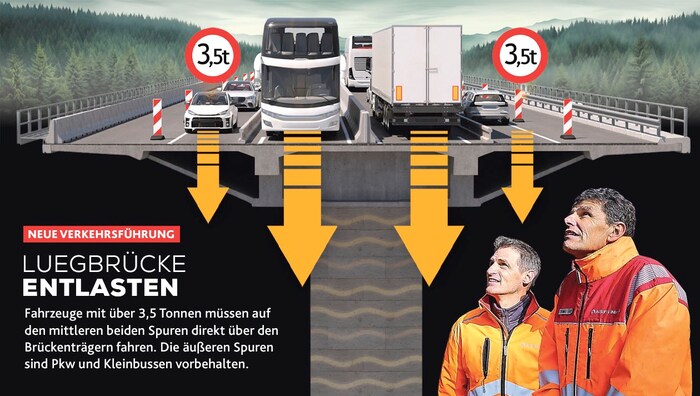
Asfinag has put together a whole package of measures to prevent traffic gridlock on the Brenner highway during the construction of the new Lueg Bridge. The basis for this is a test run in the summer with two lanes only at peak times. Trucks had to switch to the left lane to relieve the load on the supporting structure (see graphic).
This mode will be maintained from January 1. One lane is the normal case, with two lanes in each direction only during vacation periods, on a total of around 170 days. A precise timetable is currently being drawn up in consultation with the Ministry.
Total closure for trucks planned
One passage in this could again cause quite a stir among the international freight lobby: This is because a full closure of the bridge to truck traffic is planned for 15 days. Asfinag Managing Director Stefan Siegele explains that a mere dosage is no longer sufficient, as was shown during the test phase on busy days.
Facts and figures
- 170 days a year two lanes are available in the southbound direction, 160 days in the northbound direction. This is to prevent mega traffic jams at peak travel times.
- Control points: To protect the bridge as much as possible, heavy traffic is not allowed to drive on the edges, but in the middle of the structure. A scale ensures that the correct lane is used. Anyone who is too heavy will be diverted and allowed to try again.
Further measures planned
The timetable contains further measures to prevent delays and traffic jams and to protect communities from evasive traffic:
- Barrier systems are to be installed at junctions.
- Additional traffic cameras, including on the Brenner federal highway, will improve real-time traffic monitoring.
- Asfinag is investing 12 million euros in the expansion of the display systems on the entire access route and at the Brenner Pass.
- A control system with scales ensures that trucks always use the correct lane - namely the one on the inside.
- A Europe-wide campaign involving the navigation system providers is to provide information about the project.
"The result is clear"
In the "Krone" interview, Asfinag Managing Director Stefan Siegele explains the condition of the bridge, which was built in the 1960s.
"Krone": Mr. Siegele, what did the most recent structural inspection show?
Siegele: It showed that the load-bearing structure needs to be structurally relieved. The single lane will therefore be the regular traffic route from January 1st. This is the only way we can keep the bridge safe.

What are the conclusions from the test phase with two lanes?
The test run in the summer has shown: Crossing traffic worked. On many days, over 90 percent of heavy traffic followed the new traffic routing. However, it was also found that the capacity of this traffic routing is reached once a certain number of heavy vehicles per hour is reached.
It was therefore clear that further measures were needed on selected days. It was also realized that a control system would have to be set up on site.
This article has been automatically translated,
read the original article here.











Da dieser Artikel älter als 18 Monate ist, ist zum jetzigen Zeitpunkt kein Kommentieren mehr möglich.
Wir laden Sie ein, bei einer aktuelleren themenrelevanten Story mitzudiskutieren: Themenübersicht.
Bei Fragen können Sie sich gern an das Community-Team per Mail an forum@krone.at wenden.