"Europa Clipper" launch
Probe to research life on Jupiter’s moon
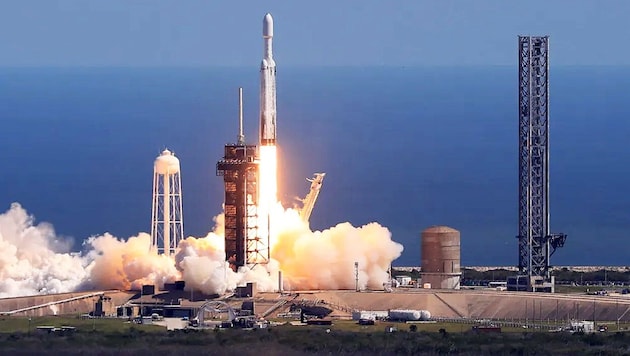

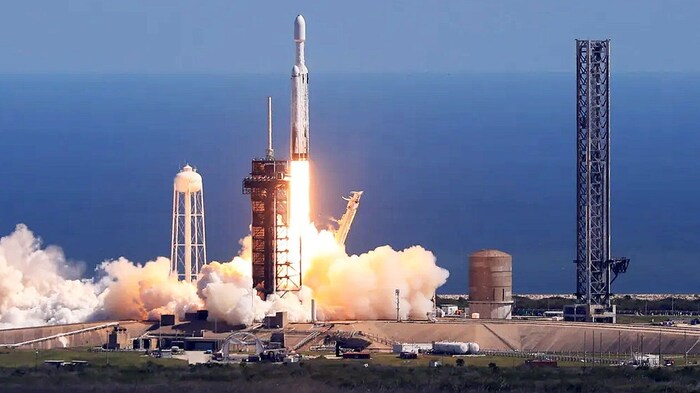
NASA's Europa Clipper probe lifted off from NASA's Kennedy Space Center in Florida on Monday aboard a SpaceX Falcon Heavy rocket on its astrobiological mission to Jupiter's moon Europa. The launch had been postponed several times due to Hurricane Milton.
 Kronen Zeitung als bevorzugte Google-Quelle hinzufügen
 "Europa Clipper" is scheduled to reach Jupiter's moon Europa in April 2030. With this mission, the US space agency NASA wants to find out more about Europa - one of Jupiter's dozens of moons. The mission is also investigating the question of whether there is another celestial body in our solar system besides Earth on which life could be possible.
Ocean of liquid water under the ice
Scientists assume that there is an ocean of liquid water beneath the icy surface of the moon Europa. The mission will not directly search for signs of life, but rather for the answer to the question: Does the moon Europa have the conditions that would make life possible?
"Europa is one of the most promising places to look for life beyond Earth," said NASA representative Gina DiBraccio at a press conference last month. It's "not about exploring a world that could have been habitable billions of years ago" like Mars, "but a world that could be habitable today, right now," explained researcher Curt Niebur, who is involved in the Europa Clipper program.
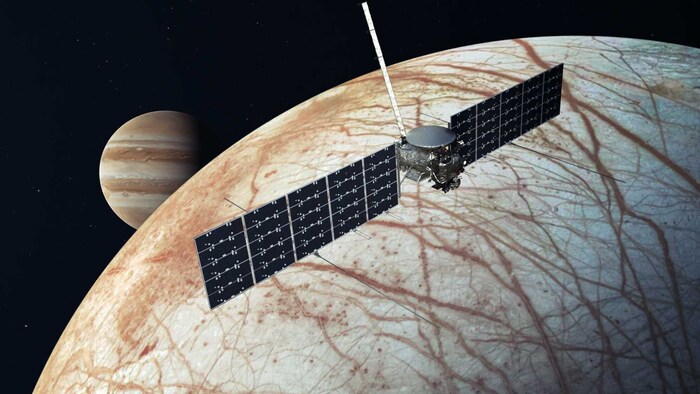
Never before has NASA planned such a large probe (see illustration below) for an interplanetary investigation. It is 30 meters wide when its huge solar panels are fully deployed to capture the faint light reaching Jupiter.
Numerous instruments on board
"Europa Clipper" is equipped with numerous sophisticated instruments, including cameras, radar, a spectrograph and a magnetometer to measure its magnetic forces. The mission aims to determine the structure and composition of Europa's icy surface, the depth and even the salinity of its ocean.
It will also investigate how Jupiter and Europa interact - for example, to find out whether water reaches the surface in some places. The aim is to find out whether the three components necessary for life are present: Water, energy and some chemical compounds.
This article has been automatically translated,
read the original article here.











Da dieser Artikel älter als 18 Monate ist, ist zum jetzigen Zeitpunkt kein Kommentieren mehr möglich.
Wir laden Sie ein, bei einer aktuelleren themenrelevanten Story mitzudiskutieren: Themenübersicht.
Bei Fragen können Sie sich gern an das Community-Team per Mail an forum@krone.at wenden.