LOWER AUSTRIA IN FIGURES
Immigration, relocation and cultures: who lives in the state?
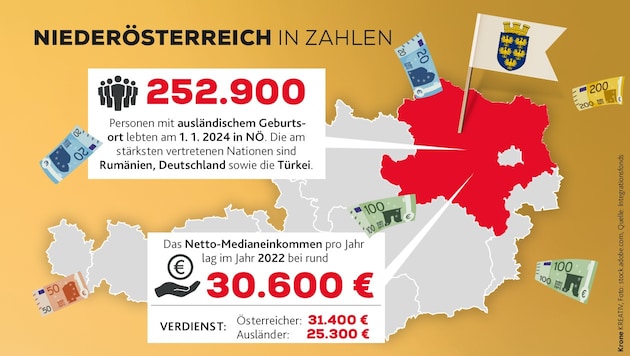

People like to live and work in Lower Austria: 14.7 percent of residents were born abroad. Today you can also read: How much people earn in our homeland - and who is more likely to be looking for a job.
 Kronen Zeitung als bevorzugte Google-Quelle hinzufügen
 Almost 252,900 people with a foreign place of birth lived in Lower Austria at the beginning of this year. This figure corresponds to 14.7% of the total population. 50.8% of those born abroad came from third countries. The most strongly represented nations were Romania, Germany and Turkey. In the city of Wiener Neustadt, the proportion of foreign-born was highest at 27.4%. The Austrian Integration Fund, which regularly provides brochures and figures on this topic, provided the latest data on the occasion of the national holiday.
Those without a job
Another important point that reflects integration: in 2023, the unemployment rate among Austrians in Lower Austria was 5.6%, slightly higher than the national average (5.3%). However, at 7.0%, the unemployment rate among foreign nationals was well below the Austrian average of 9.6%, but has risen slightly compared to 2022 (+0.4 percentage points).
A look at the schools
Last school year, 18.7% of pupils had a first language other than German. This proportion has risen by 1.7 percentage points since 2017/18. A breakdown of the individual school types shows that children with non-German as their first language take different routes through the education system. At special schools (28.8%), new secondary schools (25.2%), polytechnic schools (23.4%) and elementary school (23.0%), the proportion of pupils with a non-German first language was higher than the average. In contrast, only 14.6% of pupils at BHS, 11.4% at AHS and 4.0% at vocational schools had a first language other than German.
Income is rising!
The average net income of employed persons in 2022 was around 30,600 euros per year, which corresponds to an increase of almost 4,400 euros since 2017. Austrians earned around 31,400 euros, while working foreigners only earned around 25,300 euros. And another interesting detail: the number of naturalizations in the vast country rose by almost 13 percent in the first half of this year.
This article has been automatically translated,
read the original article here.











Da dieser Artikel älter als 18 Monate ist, ist zum jetzigen Zeitpunkt kein Kommentieren mehr möglich.
Wir laden Sie ein, bei einer aktuelleren themenrelevanten Story mitzudiskutieren: Themenübersicht.
Bei Fragen können Sie sich gern an das Community-Team per Mail an forum@krone.at wenden.